
Sunglasses Are Already Dark, So Why Check the UV Label?
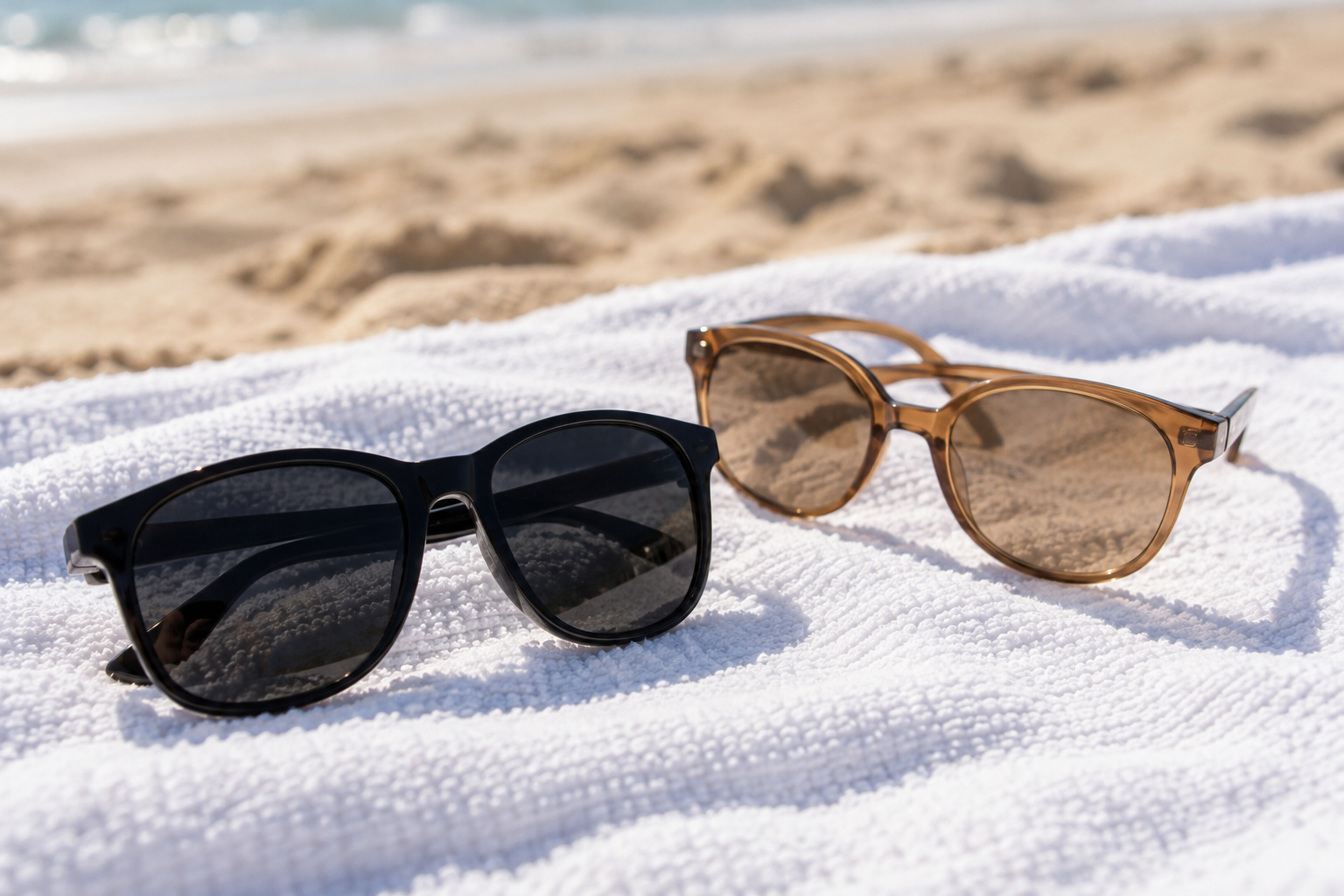
Try on jet-black sunglasses at a street stall while travelling and the world dims at once, and your eyes seem more comfortable. Surely that blocks all the sunlight, yet inside the arm or on a sticker there is a separate mark such as “UV400”. Why does an already dark lens need another label?
How dark a lens is concerns visible light, and that alone cannot tell you how much ultraviolet it blocks.
This article looks at the difference between tint density and UV labels, and explains the standards in the US, Australia and the UK, naming the country each time. UV percentages on contact lens boxes are covered separately in our article on UV numbers.
Being dark and blocking are two different things
Cancer Council Australia's eye protection fact sheet states that a lens's darkness or colour does not indicate its level of UV protection. Dark or polarized lenses may help reduce glare, it explains, but that does not make them an indicator of UV protection.
The same source gives an example in the opposite direction. Under the Australian standard for work protective eyewear, it says, clear eyewear with an outdoor “O” mark has sufficient UV protection for outdoor use. So a lens can block UV with no tint, and a deep tint alone tells you nothing about it.
According to the US National Eye Institute's explanation, UVA is 315–400 nanometres and UVB is 280–315 nanometres. Looking at a lens cannot tell you how much of this range passes through, so testing and labelling are needed separately.
If UV passes through a dark lens
A 2016 review paper from the Australian Competition and Consumer Commission (ACCC) addresses this situation. It says sunglasses that absorb visible light but do not block UV can be more harmful than wearing none. It adds the explanation that with bare eyes you squint and your pupils narrow, whereas behind a dark lens the pupils are enlarged.
The same paper sums up that prolonged UV exposure raises the risk of eye problems, including cataracts. This is what an Australian regulator set out when explaining the need for a safety standard.
This explanation cannot be used to judge whether a particular pair of sunglasses is dangerous or whether you have a problem with your eyes. If you have eye symptoms, it is best to check with an ophthalmologist or optometrist.

What does the 400 in UV400 tell you?
The 400 is a wavelength: 400 nanometres. It is the same number as the end of the UVA range above. The aim of the label is to cover the UV range up to its end, but sources explain differently what percentage it means is blocked.
The US National Eye Institute advises looking for lenses that block 99–100% of UVA and UVB, or lenses labelled with a UV400 rating. The Cancer Council Australia fact sheet says a UV 400 label means blocking at least 95% of UV from 190 to 400 nanometres. The numbers in these two public sources are not the same.
With public sources differing like this, it is more accurate not to assume “100% blocking” from this label alone. It helps to see whether the product also states which standard it was tested against.
In the US, sunglasses are a medical device
Countries also differ in how they handle this labelling. First, a slightly surprising fact: US federal regulation 21 CFR 886.5850 defines non-prescription sunglasses as a device to protect the eyes from bright sunlight and classifies them as Class I. This is a separate category from glasses that correct vision.
The US Food and Drug Administration (FDA)'s 1998 guidance lists ANSI Z80.3-1996 as one voluntary standard and explains that its UV requirements can serve as a basis for labelling. It also notes that untrue UV protection claims can be a problem. It is an old document and the standard has been revised since, so if a year appears with the label, it is worth noticing.
Australia gives lenses a category
Australia's 2017 consumer goods safety standard takes AS/NZS 1067.1:2016 as its basis. According to the Cancer Council Australia fact sheet, lenses are divided into categories from 0 to 4, and labels must include this standard and the category. Categories 0 and 1 are fashion spectacles and not sunglasses, while category 4 is a very dark special lens not suitable for road use. Here too, the idea that darker is better does not hold.
There is also a difference of one number. The ACCC's 2016 paper compares the Australian standard, which covers up to 400 nanometres, with the ISO and ANSI standards of the time, which went up to 380 nanometres. It also includes the opinion of Australian experts that up to 40% of UV energy lies in the 380–400 nanometre range.
However, the same paper also includes an industry expert's opinion that overseas products in practice usually block up to 400 nanometres as well. The number in a standard and the performance of products on the market should be read separately.

In the UK, look at the markings together
The 2024 guidance from the College of Optometrists, the UK's professional body for optometrists, recommends choosing sunglasses with good UV protection and looking for the British Standard (ISO 12312-1:2022) and a CE or UKCA mark. The ACCC paper's 380-nanometre figure for ISO was a comparison of the edition current in 2016, so that number is best not carried over to the present edition.
National standards, then, differ in name, in what they cover and in when they were revised. Even the same words “UV protection” can mean slightly different things depending on which standard, from which country, is meant.
One line of small print, not the lens colour
Darkness has to do with how you experience glare, and a UV label has to do with light you cannot see. That polarization is yet another separate property is shown in our article on polarized sunglasses.
If there is a label, look beyond the number to which standard it names and whether it gives a category. If there is no label, or you do not know what it means, you can ask the seller or an eyewear professional what it was tested against.
Next time you pick up sunglasses, before holding the lenses to the light, read the small print inside the arm and on the label. The information a dark lens will not tell you is in that one line.