
Did Glasses Always Have Temple Arms?
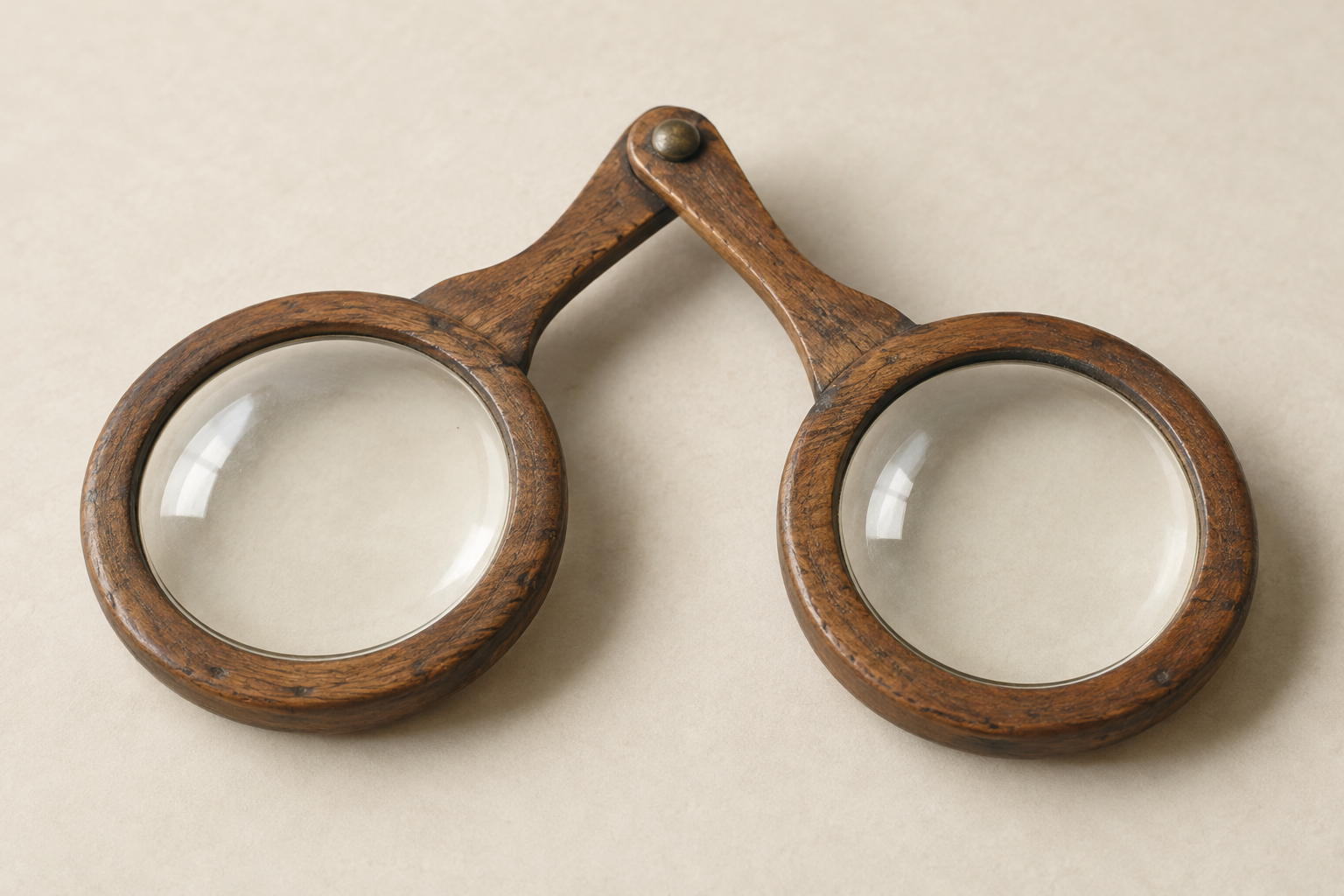
You unfold your glasses, place them on your nose and slide the arms behind your ears. It is so familiar that no thought is needed. Yet some spectacles had two lenses and no arms at the sides.
How did they stay in place while reading? What happened when someone bent their head or turned a page? Old spectacles reveal a problem alongside making clear lenses: keeping them on a face.
This is not a timeline fixing a single invention date for modern arms. It is a short historical walk through different structures and the many attempts behind a way of wearing glasses we take for granted.
Two lenses, but a hand was needed
The UK College of Optometrists' history of spectacles introduces early rivet spectacles as two lens rims joined together. Without side arms, they needed to rest on the nose or be supported by hand.
Imagine your own glasses without their arms: one hand holding them, the other turning a page. This is an illustration of the structural difference, not a documented account of a particular historical user. It shows how much convenience comes from outside the lenses themselves.
When examining an old object, look at its side as well as the round lenses in front. Similar-looking lenses may require different movements depending on how the frame is held or worn.
Early arms did not curve behind the ears
The same guide links eighteenth-century London optician Edward Scarlett with the development of arms that held the sides of the head. They differed from today's ear-wrapping shape. It also describes the relevance of contemporary dress, including wigs.
Reading “arms were added” should not place modern plastic temples unchanged into the past. Names may be familiar while contact points and end shapes were different.
Technology often develops through changes to separate parts rather than a complete modern product appearing at once. Distinguishing lens-making from head-retention design makes the history easier to see.

The loops at the ends were not just decoration
Reading Museum's collection learning sheet explains that eighteenth-century arms generally did not curl around the ears, and looped ends helped grip the sides of the head. It then estimates one example with a rotating side structure to date from the mid-nineteenth century.
Such descriptions draw attention to small joints. Today's shopper may notice colour and lens shape first, while makers also had to address folding and sufficient arm length. Still, interpret an individual object's purpose with its museum description rather than shape alone.
Keep approximate dates approximate. Not every object from centuries ago has an exact manufacturing date. Replacing a date range with a single year makes a stronger claim than the source.
Other forms did not immediately disappear
The development of arms did not instantly eliminate other designs. Just as eyewear varies with purpose today, different handheld and face-retained forms coexisted historically.
The Science Museum Group's collection records document forms including eighteenth-century metal-framed spectacles and nineteenth-century folding hand-held eyeglasses. Comparing dates and categories suggests a history more complex than one form entirely replacing another.
A cord or handle in an old portrait is worth noticing too. A picture alone need not establish the exact name or purpose. Ask how the object might have been held, then compare with descriptions of real museum examples.
An optical museum holds more than lenses
The British Optical Association Museum's collections guide includes examination equipment, trade material, advertising, paintings and photographs as well as spectacles. These help record use and culture beyond structure alone.
A frame shows that a particular shape existed. Advertising or portraits add clues about how people presented it and themselves. That connects with our experience of glasses as both practical tools and part of appearance.
Look beyond “that would still look stylish.” Consider the hand movements needed, storage, clothing and hairstyle. Separating what records establish from what remains imagined is part of enjoying history.

What to notice on today's glasses
Unfold your own glasses and look at the bridge, hinges and arm tips. Each has a job. We see through lenses, but surrounding structures keep them in the intended position. The history is about clarity and wearing convenience developing together.
The images here are generated illustrations of historical structures and modern glasses, not photographs of museum objects. Check the linked collection material for the precise form and dating of individual artefacts.
Next time you fold your glasses into their case, notice the small arms too. Keeping two lenses comfortably on a face is an old design problem. Its history lives in a movement we perform without thinking.