
Is the Pattern on a Coloured Lens Inside It or on the Surface?
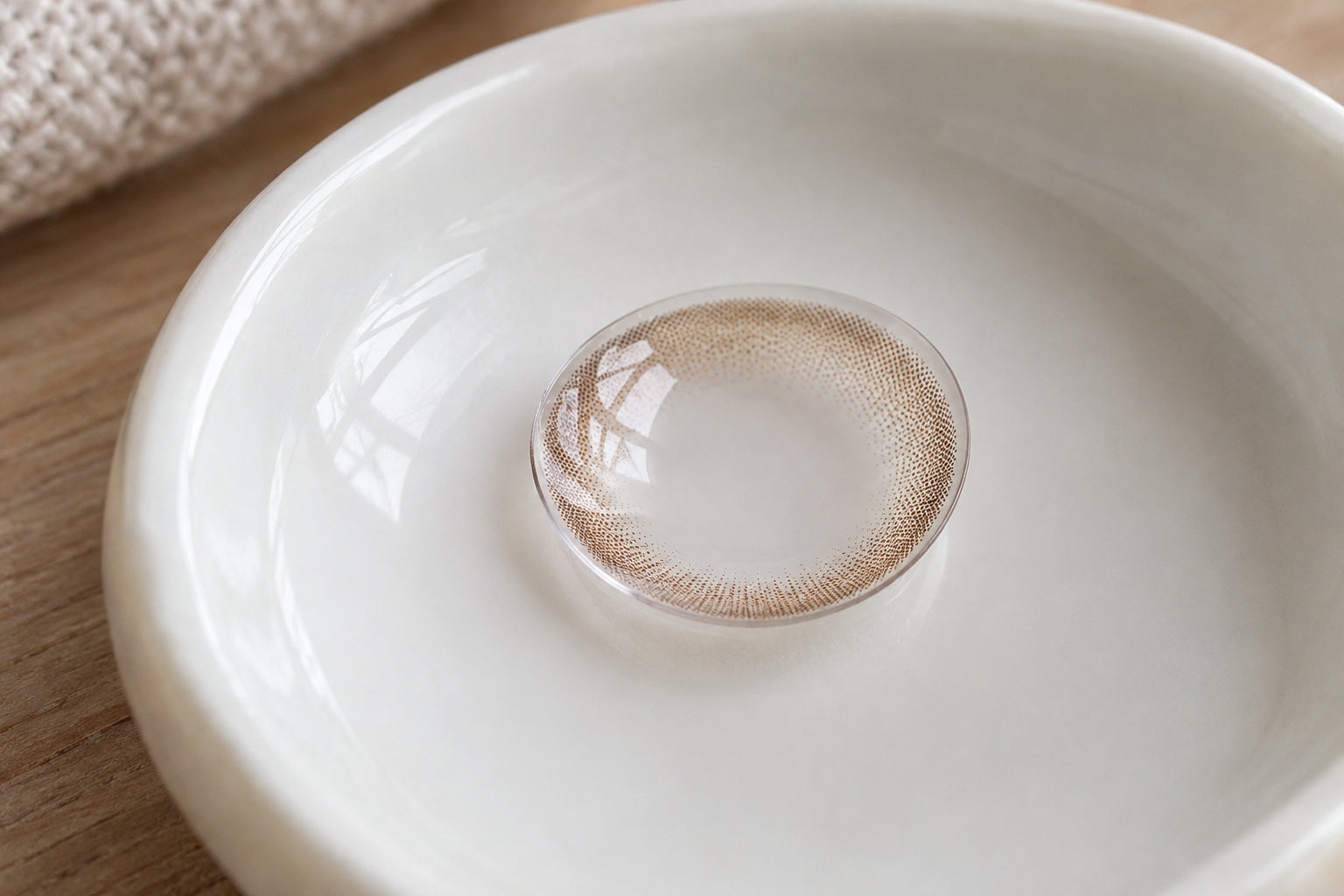
Rest a coloured contact lens on your palm and hold it up to the light, and the rim that looked smoothly brown from a distance may turn out to be made of tiny dots and lines. In the middle, a clear circle is left empty. Is this pattern sealed inside the lens, or printed on the outside?
The pattern is made by printing or painting on pigment, but whether that pigment sits on the surface of the lens or is enclosed within clear material depends on how the lens is made.
This article looks in turn at several ways of adding a pattern, US rules on colour additives, and research on surface pigment. It is not an article judging whether any particular product or company is good or bad.
An iris drawn in dots
Can colour be added to the iris while still letting the texture of the natural iris show through? That was exactly the goal set out in Julius Z. Knapp's US Patent 4,582,402, and the answer was dots. Filed in April 1984 and granted in April 1986, the patent describes printing opaque dots, spaced apart, on the part of the lens that covers the iris. Each dot is about 0.1mm in diameter, and the dots are arranged so that their centres form equilateral triangles. The dots cover at least 30% of the iris area, with around 50% considered preferable.
The key is the gaps between the dots. The patent leaves the gaps uncoloured so that the texture of the wearer's iris shows through. The dots are made small enough not to be noticed individually at normal distances, and the pupil area is left clear. How natural eye colour and the design combine is covered in why the same coloured contact looks different on different people.
Pad printing, like a stamp
How are the dots printed? The method the same patent names as preferred is pad printing. Ink is applied to a plate with the pattern engraved into it, and the ink is wiped off the flat surface, leaving ink only in the recessed grooves. A soft pad is pressed onto the plate to pick up the ink and then pressed onto the lens to transfer the pattern. It is similar to printing with a rubber stamp.
In this patent's claims, the pattern is placed “on the surface” of the lens. If the pattern is printed onto a finished lens, the pigment sits in a position exposed on the outside of the lens.

Printed on the mould first, then into the lens
A method that reversed the order also appeared. A European patent application naming Tomas Pförtner as inventor (EP0357062, priority date 1988) points out that a colour layer placed on the lens surface is directly exposed to the eye's fluids, such as tears.
The idea of this application is to print the pigment first not on the lens but on the convex or concave face of the mould used to make it. When lens material is filled into that mould, set and then released, it explains, the iris pattern transfers from the mould into the body of the lens and settles near its back surface. In effect, the colour goes in at the moment the lens is made, instead of being added on afterwards.
Between two clear layers
There is also a method of trapping the pigment entirely between clear layers, commonly called a sandwich structure. Interestingly, one of its early records bears the name of Otto Wichterle, the Czech chemist who pioneered soft lens material.
US Patent 3,679,504 was granted in 1972 on the basis of a 1968 Czechoslovak application, and its holder is the Czechoslovak Academy of Sciences. The patent describes placing a colour pattern between at least two layers of clear hydrogel and bonding the two layers by setting the same or a similar material between them. A thin clear layer is first made on a smooth plate, and then either a pattern in the form of a thin film is inserted between that layer and the lens, or a pattern is painted onto one of the surfaces.
In the United States, colourants must be on the list too
The colour additives used in the patterns are themselves regulated. The US Food and Drug Administration (FDA)'s summary of colour additives lists the colour additives that may be used in medical devices, and more than twenty are approved for contact lenses alone. Among them are iron oxides and titanium dioxide (1986) and mica-based pearlescent pigments (2002). One item, for colour formed inside soft lenses to mark left and right, is permitted only up to 0.11 micrograms per lens.
Why do even lens colourants have to be listed? The Federal Register rule issued by the FDA in 1995 when it added a lens colour additive explains that because lenses sit on the eye for several hours a day, every day, for a year or more, the colour additive is in direct contact with the body for a significant period. The colour additive in this rule was one that bonds chemically while the lens material sets, becoming one with the material. In a 2011 rule adding another lens colour additive, the FDA likewise judged that because the colour additive was bound within the lens material, it was very unlikely to migrate into the eye, and required that the amount used not exceed the minimum needed to produce the desired colour.
This is the US standard; rules in other countries need to be checked separately. Why coloured contacts without corrective power are treated as prescription items in the United States can be found in our article on 0.00-power coloured contacts.

A difference revealed by rubbing
Whether the pigment is on the surface or inside can be checked in a laboratory. According to a 2013 announcement by The Hong Kong Polytechnic University, a research team from the university's optometry school took coloured lenses from 15 brands, obtained from optical shops, consignment counters and online sellers, and rubbed five lenses of each brand using a standardized method.
Pigment came off in 13 of the 15 brands, meaning that the pigment was on the surface rather than enclosed within the lens. In an experiment exposing them to microbes, at least six times as many microbes attached to these lenses as to those of the 2 brands that passed the rubbing test. The lenses that passed showed no clear difference from the clear lenses used for comparison.
This was a laboratory test on samples from 15 brands. It was not a study measuring whether wearers actually developed more infections, nor is it a conclusion that applies as it stands to all coloured lenses. If you have pain, redness or a change in vision while wearing lenses, it is best to check with an ophthalmologist or optometrist.
A tiny print in the palm of your hand
The pattern on a coloured lens is the combined result of printing technology that lays down dots, techniques that use moulds and clear layers to bring the colour inside, and rules that set which colour additives may be used and in what amounts. Even with the same brown pattern, where the pigment sits depends on how the lens is made.
Next time you have a chance to look at a coloured lens, hold it up to the light and look for the gaps between the dots and the clear circle in the middle. On a dot-pattern lens, those gaps are the windows that let the wearer's iris show through.